
Epoxy Calculator
Estimate how much epoxy resin to buy before you mix. Choose the project type, enter dimensions and pour depth, and the calculator gives the total volume in litres, US gallons and fluid ounces, splits it into resin and hardener by your mix ratio, adds a waste allowance, and tells you how many kits to buy.
- Free to use
- No sign-up
- Runs in your browser
Epoxy volume calculator
Epoxy Project Planner
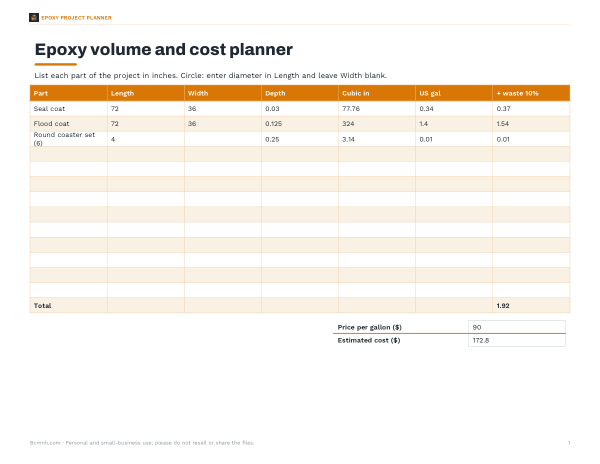
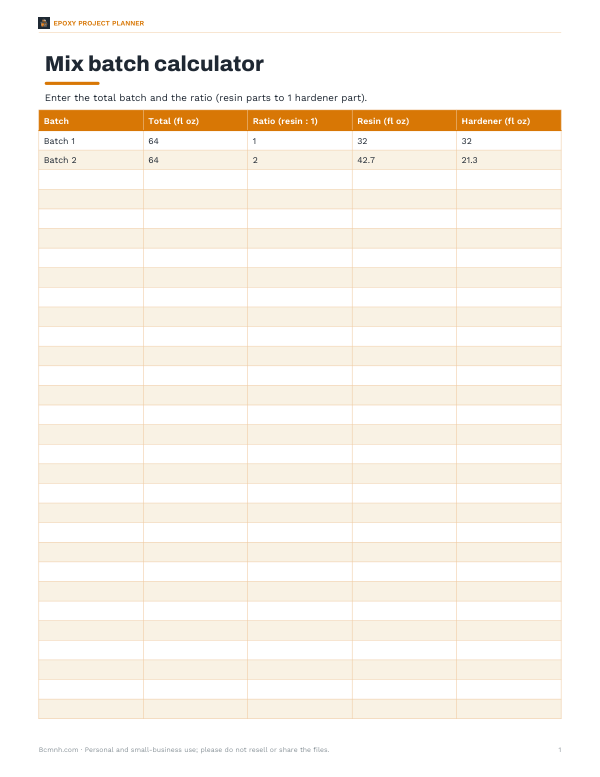
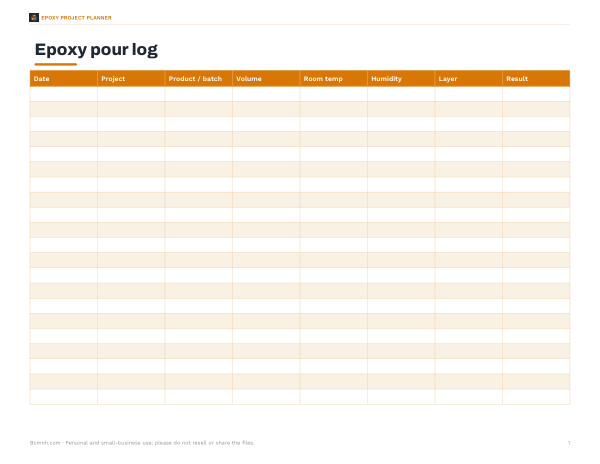
Excel epoxy project planner with multi-part volume calculator, mix batch sheet by ratio, cost estimator, and a printable pour log and safety checklist.
- Volume & cost planner (XLSX)
- Mix batch sheet (XLSX, PDF)
- Pour log (PDF, DOCX, XLSX)
- Safety & prep checklist (PDF, DOCX)
Formats: XLSX, PDF, DOCX. Instant download after payment (link valid 72 hours, up to 5 downloads). AI-assisted: the templates were drafted with AI help and reviewed and laid out before publishing.
$4.00 USD, one-time 4 files · about $1.00 each
- Instant download
- 7-day refund
- Secure checkout by Stripe
7-day money-back guarantee. Full refund within 7 days of purchase, even after you download.
Free sample: Epoxy Safety Checklist (PDF, 56 KB)
Full refund within 7 days — see the refund policy and license.
Free printables
Single sheets you can print right now, no sign-up. The full pack adds every sheet in one download plus the editable files.
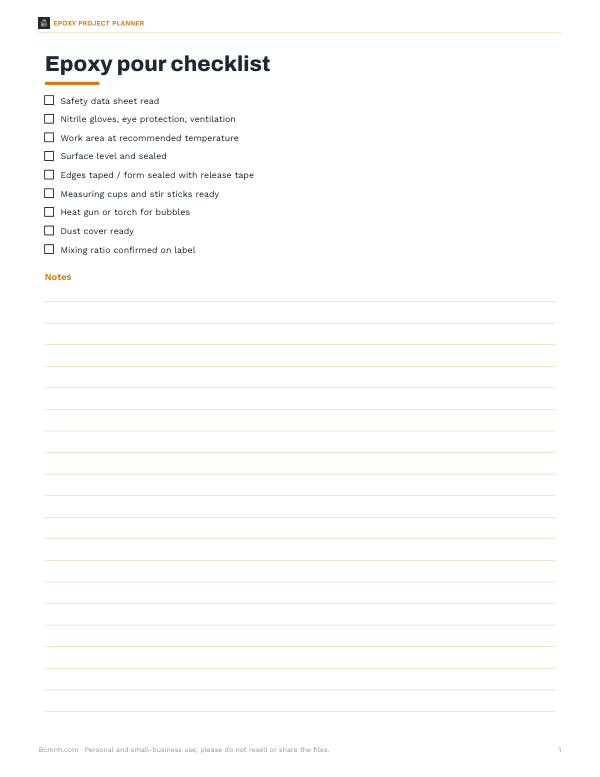 Printable Epoxy Pour Checklist
How to calculate epoxy volume
Epoxy volume is simply the space you need to fill: length × width × depth for a rectangle, π × radius² × depth for a circle. Convert the result to litres or gallons: 1 litre = 1,000 cm³ and 1 US gallon = 231 cubic inches (3.785 litres). Then add a waste allowance — resin left in the mixing cup, on the stirrer and dripping over edges — typically 5–15%. For a flood coat, depth is the coat thickness, usually about ⅛ inch (3 mm), which is how self-levelling table-top epoxy spreads.
Quick reference
| Project | Typical depth | Volume per square foot | Per m² |
|---|---|---|---|
| Seal coat (thin brushed layer) | 1/32" (≈0.8 mm) | ≈2.5 fl oz | ≈0.8 L |
| Flood coat | 1/8" (≈3 mm) | ≈10 fl oz | ≈3.2 L |
| Double flood coat | 1/4" (≈6 mm) | ≈20 fl oz | ≈6.4 L |
| Deep pour layer | 1–2" (25–50 mm) | ≈80–160 fl oz | ≈25–50 L |
One square foot at ⅛ inch is 144 × 0.125 = 18 cubic inches, or about 0.078 US gallon (10 fl oz). One square metre at 1 mm is exactly 1 litre.
Worked example: dining table top
A 72 × 36 inch table top with a ⅛ inch flood coat needs 72 × 36 × 0.125 = 324 cubic inches, which is 1.40 US gallons (5.3 litres). Adding 10% waste gives 1.54 gallons. With 1:1 epoxy, that is about 0.77 gallon each of resin and hardener, so two 1-gallon kits (each 0.5 gal resin + 0.5 gal hardener) are enough with a little spare. A seal coat beforehand adds roughly another third of a gallon.
Worked example: river table
A river table 72 inches long with an average river width of 8 inches and slab thickness of 1.75 inches needs 72 × 8 × 1.75 = 1,008 cubic inches, or 4.36 US gallons. With 10% waste, plan for about 4.8 gallons of deep-pour epoxy. Many deep-pour products are limited to 1–2 inches per pour, so this may be poured in one or two layers depending on the product. Seal the wood edges with a thin coat first to reduce bubbles from the grain, and build a well-sealed form with release tape.
Mix ratios and why they matter
| Ratio | Resin share | Hardener share | Typical products |
|---|---|---|---|
| 1 : 1 | 50% | 50% | Table-top and coating epoxies |
| 2 : 1 | 67% | 33% | Many casting and deep-pour resins |
| 3 : 1 | 75% | 25% | Some deep-pour and art resins |
| 4 : 1 | 80% | 20% | Some marine and laminating epoxies |
Mix exactly at the ratio on the label — by volume or by weight, whichever the manufacturer specifies (they are not always the same because resin and hardener have different densities). Off-ratio mixes may stay tacky or soft. Scrape the sides and bottom of the cup while mixing, then pour into a second cup and mix again for the best cure.
Coating vs deep pour epoxy
- Table-top (coating) epoxy is thicker, cures faster and is designed for layers around ⅛ inch. Pouring it too deep can overheat and crack.
- Deep-pour (casting) epoxy is thinner, cures slowly and releases heat gradually, allowing pours of 1–4 inches depending on the product.
- Always check the maximum pour depth on the product data sheet, and the working temperature range — cold resin is thick and traps bubbles.
Tips for a successful pour
- Work at the temperature the manufacturer recommends, often around 70–80 °F (21–27 °C).
- Seal porous wood with a thin seal coat to stop air escaping into the flood coat.
- Level the surface carefully — epoxy flows to the low side.
- Tape the underside edges to catch drips, and remove the tape before the resin fully cures.
- Pass a heat gun or torch briefly over the surface to release bubbles.
- Cover the piece to keep dust off while it cures.
- Wear nitrile gloves, eye protection and work with ventilation; follow the safety data sheet.
Estimating for irregular shapes
For free-form pieces such as live-edge slabs, charcuterie boards or irregular molds, estimate the area with a grid: lay a sheet of graph paper or a photo with a grid over the piece, count full squares and half the partial squares, and multiply by the square size. Another method is to fill a mold with water or rice, measure the volume with a measuring jug, and use that figure directly (dry the mold thoroughly before pouring resin). For shallow coatings on uneven surfaces, add a larger waste allowance, around 15–20%, because resin pools in low areas and runs off edges.
Converting between units
| From | To | Multiply by |
|---|---|---|
| Cubic inches | US gallons | ÷ 231 |
| Cubic inches | US fl oz | × 0.554 |
| US gallons | Litres | × 3.785 |
| Litres | US fl oz | × 33.81 |
| Cubic centimetres | Litres | ÷ 1,000 |
Frequently asked questions
How much epoxy do I need for a table top?
Length × width × thickness; a ⅛ inch flood coat needs about 10 fl oz per square foot, plus 10% waste.
How thick is a flood coat?
Usually about ⅛ inch (3 mm), because table-top epoxy self-levels to around that thickness.
How much epoxy for a river table?
Length × average river width × slab thickness, plus waste; convert cubic inches to gallons by dividing by 231.
Can I pour table-top epoxy 2 inches deep?
Not usually. Use a deep-pour product rated for that depth, or pour in thin layers.
How much waste should I allow?
5–15%, more for small projects and multiple mixing batches.
How long does epoxy take to cure?
Coating epoxies are often hard in about 24 hours and fully cured in several days; deep-pour resins can take days to harden. Follow the product’s data sheet.
Is the calculation stored?
No, it runs in your browser only.